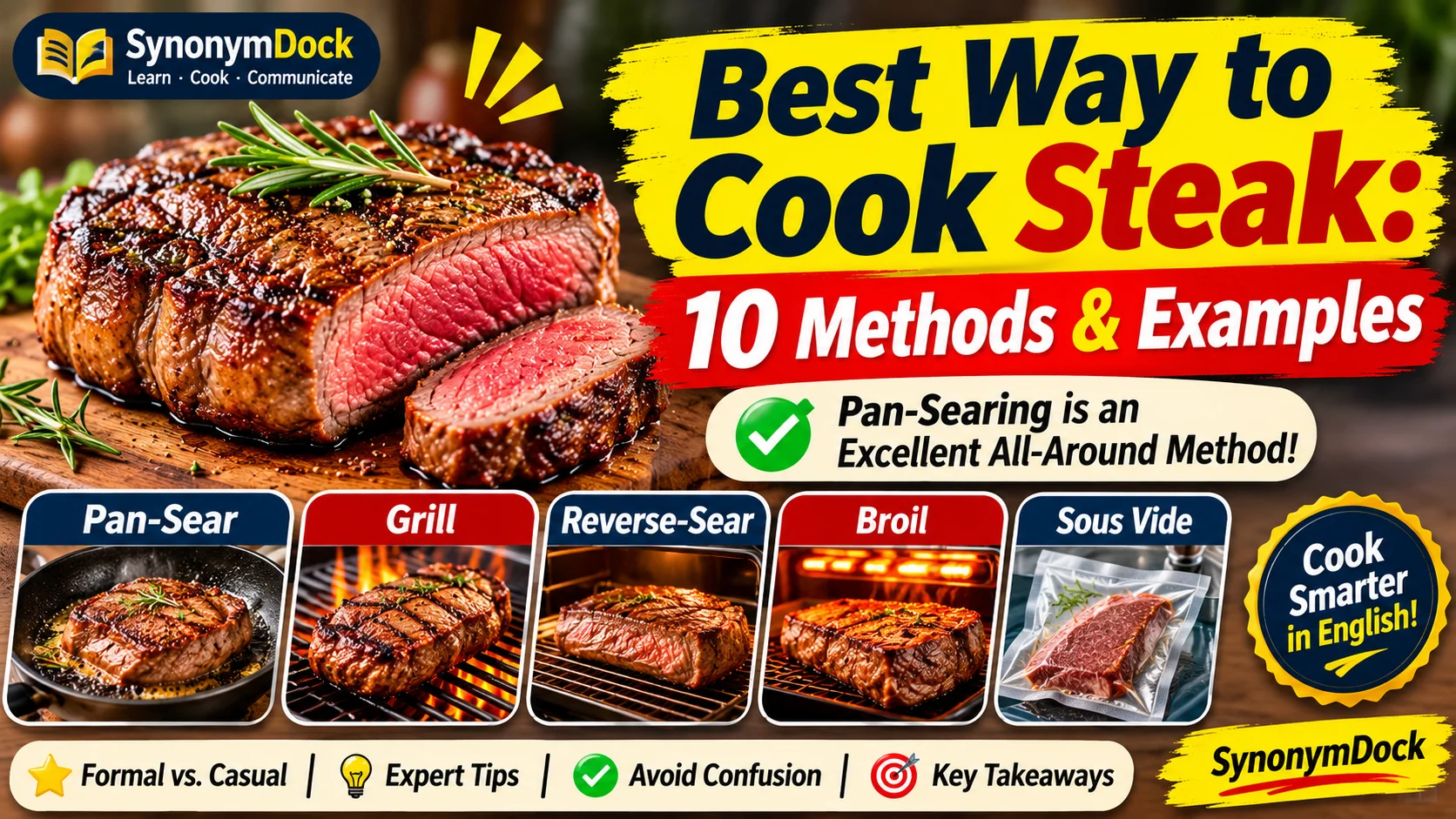
The best way to cook steak for a flavorful crust and juicy center is pan-searing in a hot skillet. Other excellent methods include grilling reverse-searing broiling and sous vide depending on thickness equipment and personal preference.
Finding the best way to cook steak depends on the cut thickness available equipment and flavor you enjoy. Some people prefer a crispy exterior while others want an evenly cooked tender center.
Understanding different cooking methods also improves your English vocabulary. Words such as sear grill roast and broil describe specific techniques rather than interchangeable actions.
This guide explores ten steak-cooking methods explains their meanings and provides practical examples. English learners students writers and food enthusiasts can use these expressions confidently.
Quick Guide: Steak Cooking Methods by Category
Formal Cooking Terms
- Pan-searing
- Roasting
- Broiling
- Sous vide
Pro Tip: Use precise cooking terminology in recipes and professional food writing.
Professional Cooking Expressions
- Reverse-searing
- Butter-basting
- Charcoal grilling
- Oven-finishing
Pro Tip: These expressions help explain techniques in restaurant menus and kitchen instructions.
Business and Food-Writing Alternatives
- Prepare steak in a skillet
- Cook steak over direct heat
- Finish steak in the oven
- Apply a high-heat sear
Pro Tip: Use clear action verbs when writing professional recipes.
Academic and Educational Expressions
- Dry-heat cooking
- Moist-heat cooking
- Temperature-controlled cooking
- Direct-heat preparation
Pro Tip: These expressions work well in culinary education and technical explanations.
Casual Expressions
- Sizzle a steak
- Throw a steak on the grill
- Cook it in a hot pan
- Give it a quick sear
Pro Tip: Casual expressions sound natural in everyday conversations.
What Does Best Way to Cook Steak Mean?
The phrase best way to cook steak refers to the most suitable cooking method for achieving a preferred combination of flavor texture tenderness and doneness.
Grammatically it is a noun phrase. The word best is a superlative adjective describing the most suitable method.
For example:
The best way to cook steak is to sear it in a hot skillet and monitor its internal temperature.
The word best is subjective here. A method that works beautifully for a thin sirloin might not be ideal for a thick ribeye.
What Is the Best Way to Cook Steak?
For most home cooks preparing one or two steaks pan-searing is an excellent starting point. It creates direct contact with a hot cooking surface and helps develop a deeply browned crust.
A Simple Pan-Seared Steak Method
- Choose a steak approximately 1–1.5 inches thick.
- Pat the surface completely dry using paper towels.
- Season both sides with salt and black pepper.
- Heat a heavy skillet over medium-high to high heat.
- Add a suitable high-smoke-point cooking oil.
- Place the steak carefully into the hot skillet.
- Flip periodically and monitor its internal temperature.
- Add butter garlic or herbs near the end if desired.
- Remove the steak and allow it to rest before slicing.
Avoid relying entirely on cooking time. Thickness pan temperature and starting temperature all affect the result.
Food safety note: USDA guidance recommends cooking beef steaks to at least 145°F (63°C) followed by a three-minute rest. Use a food thermometer rather than judging safety by color. This is important even when personal doneness preferences differ.
Other Ways to Say Best Way to Cook Steak (10 Methods With Examples)
These ten expressions describe different approaches to preparing steak. They are not identical synonyms: each communicates a particular cooking technique.
Pan-Sear the Steak
Meaning: Cook steak in a hot skillet to develop a browned exterior.
Explanation: Pan-searing is one of the most useful expressions in cooking English. It sounds natural in recipes restaurant discussions and professional culinary instructions.
Formality: Neutral to professional.
Example Sentence: Pan-sear the ribeye until both sides develop a rich brown crust.
Best Use: Home cooking.
Avoid Using In: Boiling instructions.
Tone: Practical and precise.
Formality Level: ⭐⭐⭐⭐
Usage Frequency: Very Common.
CEFR Level: B2.
Common Collocations: Hot skillet golden crust cast-iron pan high heat.
Context Examples:
- Spoken English: I usually pan-sear my steak.
- Professional English: Pan-sear the meat before adding the finishing butter.
- Casual Conversation: Let’s cook it in a pan.
Grill the Steak
Meaning: Cook steak over direct heat from gas charcoal or another grill.
Explanation: Grilling is popular for outdoor cooking. It produces smoky flavors and attractive char marks when heat and timing are controlled.
Formality: Neutral.
Example Sentence: Grill the steak over direct heat until it reaches your preferred doneness.
Best Use: Outdoor cooking.
Avoid Using In: Skillet recipes.
Tone: Natural and conversational.
Formality Level: ⭐⭐⭐
Usage Frequency: Very Common.
CEFR Level: B1.
Common Collocations: Charcoal grill grill marks direct heat smoky flavor.
Context Examples:
- Spoken English: Do you know how to grill steak?
- Professional English: Grill the sirloin over controlled direct heat.
- Casual Conversation: We’re grilling steaks tonight.
Reverse-Sear the Steak
Meaning: Cook steak slowly at a low oven temperature before finishing with a hot sear.
Explanation: Reverse-searing is particularly useful for thick steaks. The gradual heating process helps achieve more even doneness before creating the exterior crust.
Formality: Professional.
Example Sentence: Reverse-sear the thick ribeye for a more evenly cooked center.
Best Use: Thick steaks.
Avoid Using In: Very quick meals.
Tone: Technical and confident.
Formality Level: ⭐⭐⭐⭐
Usage Frequency: Common.
CEFR Level: C1.
Common Collocations: Low oven final sear thick ribeye even doneness.
Context Examples:
- Spoken English: I want to try reverse-searing.
- Professional English: Reverse-sear thicker cuts before the final skillet finish.
- Casual Conversation: Cook it slowly first then sear it.
Broil the Steak
Meaning: Cook steak using intense heat from an overhead oven element.
Explanation: Broiling is similar to grilling in the way heat is applied but the heat source usually comes from above. It is useful when outdoor grilling is unavailable.
Formality: Neutral to professional.
Example Sentence: Broil the steak briefly turning it when the first side is browned.
Best Use: Oven cooking.
Avoid Using In: Slow cooking.
Tone: Instructional.
Formality Level: ⭐⭐⭐⭐
Usage Frequency: Common.
CEFR Level: B2.
Common Collocations: Oven broiler high heat upper rack browned surface.
Context Examples:
- Spoken English: Can we broil the steak?
- Professional English: Broil the steak until the surface is properly browned.
- Casual Conversation: Let’s cook it under the oven’s top heat.
Sous Vide the Steak
Meaning: Cook steak in a temperature-controlled water bath usually inside a sealed bag.
Explanation: Sous vide offers precise temperature control and consistent doneness. A separate hot sear is usually needed to develop a flavorful crust.
Formality: Technical and professional.
Example Sentence: Sous vide the steak before finishing it in a hot skillet.
Best Use: Temperature precision.
Avoid Using In: Equipment-free cooking.
Tone: Technical.
Formality Level: ⭐⭐⭐⭐⭐
Usage Frequency: Occasional.
CEFR Level: C1.
Common Collocations: Water bath vacuum-sealed bag precise temperature finishing sear.
Context Examples:
- Spoken English: Have you ever tried sous vide steak?
- Professional English: Sous vide preparation provides precise temperature control.
- Casual Conversation: Let’s cook it slowly in a water bath.
Native Speaker Tip: Alternatives 1–5
For everyday English pan-sear and grill are especially natural. Professional cooks often use reverse-sear and sous vide when discussing specific techniques. Broil is more common in American English; British English often uses grill for similar oven cooking.
Roast the Steak
Meaning: Cook steak using dry heat inside an oven.
Explanation: Roasting generally uses indirect oven heat. It is useful for larger cuts or as part of a combined cooking method.
Formality: Neutral to professional.
Example Sentence: Roast the steak gently before giving it a quick finishing sear.
Best Use: Oven preparation.
Avoid Using In: Quick skillet cooking.
Tone: Descriptive.
Formality Level: ⭐⭐⭐⭐
Usage Frequency: Common.
CEFR Level: B2.
Common Collocations: Oven roasting dry heat roasting temperature tender meat.
Context Examples:
- Spoken English: I prefer roasting larger cuts.
- Professional English: Roast the beef using controlled oven temperatures.
- Casual Conversation: Let’s put it in the oven.
Butter-Baste the Steak
Meaning: Spoon melted butter over steak while it cooks in a skillet.
Explanation: Butter-basting is a finishing technique rather than a complete cooking method. Garlic herbs and butter can add aroma and flavor.
Formality: Professional.
Example Sentence: Butter-baste the steak during the final stage of cooking.
Best Use: Flavor finishing.
Avoid Using In: Butter-free recipes.
Tone: Culinary and descriptive.
Formality Level: ⭐⭐⭐⭐
Usage Frequency: Common.
CEFR Level: C1.
Common Collocations: Melted butter garlic cloves fresh thyme spoon over.
Context Examples:
- Spoken English: I like to butter-baste my steak.
- Professional English: Finish the steak by basting it with aromatic butter.
- Casual Conversation: Pour that buttery sauce over the meat.
Sear and Oven-Finish the Steak
Meaning: Brown steak in a skillet before completing the cooking process in an oven.
Explanation: This combination gives cooks control over exterior browning and interior doneness. It is particularly helpful for thicker steaks.
Formality: Professional.
Example Sentence: Sear the steak on both sides before transferring it to the oven.
Best Use: Thick cuts.
Avoid Using In: Thin steaks.
Tone: Instructional.
Formality Level: ⭐⭐⭐⭐
Usage Frequency: Common.
CEFR Level: B2.
Common Collocations: Initial sear oven finish heavy skillet internal temperature.
Context Examples:
- Spoken English: Should we sear it before baking?
- Professional English: Sear the steak before completing the cooking process in the oven.
- Casual Conversation: Brown it first then finish it in the oven.
Charcoal-Grill the Steak
Meaning: Cook steak over burning charcoal to create smoky flavor and a charred exterior.
Explanation: This phrase is more specific than simply saying grill. It identifies the heat source and communicates a particular flavor profile.
Formality: Neutral.
Example Sentence: Charcoal-grill the steak for a distinctive smoky flavor.
Best Use: Smoky flavor.
Avoid Using In: Indoor cooking.
Tone: Descriptive.
Formality Level: ⭐⭐⭐
Usage Frequency: Common.
CEFR Level: B2.
Common Collocations: Charcoal fire smoky aroma open flame grilled crust.
Context Examples:
- Spoken English: I love charcoal-grilled steak.
- Professional English: Charcoal-grill the meat to develop a smoky exterior.
- Casual Conversation: Let’s cook it over charcoal.
Cook the Steak on a Griddle
Meaning: Prepare steak on a flat heated cooking surface.
Explanation: A griddle provides broad contact between the meat and the cooking surface. It works well for cooking multiple steaks or preparing meals indoors.
Formality: Neutral.
Example Sentence: Cook the steak on a hot griddle for an evenly browned surface.
Best Use: Flat-top cooking.
Avoid Using In: Open-flame recipes.
Tone: Practical.
Formality Level: ⭐⭐⭐
Usage Frequency: Occasional.
CEFR Level: B1.
Common Collocations: Flat-top griddle heated surface even browning cooking oil.
Context Examples:
- Spoken English: Can you cook steak on a griddle?
- Professional English: Prepare the steak on a preheated flat-top griddle.
- Casual Conversation: Let’s cook it on the flat grill.
Native Speaker Tip: Alternatives 6–10
Roast describes oven cooking while butter-baste explains how to finish meat with butter. Sear and oven-finish is especially clear in professional instructions. Native speakers usually choose the simplest accurate verb rather than an elaborate expression.
Expert Insight: Choosing the Right Expression
In workplace communication clear cooking terminology prevents confusion. A chef needs to know whether a steak should be grilled broiled or pan-seared.
In professional emails use direct instructions such as Please pan-sear the steak before serving. Avoid vague phrases such as Cook it nicely.
In academic English technical terms such as dry-heat cooking and temperature-controlled preparation communicate processes more accurately.
The same principle applies to English learning: choose vocabulary according to purpose audience and context.
Comparison Table: 10 Steak-Cooking Alternatives
| Phrase | Tone | Formality | Best Use | Frequency |
| Pan-sear | Practical | Neutral | Skillet cooking | Very Common |
| Grill | Natural | Neutral | Outdoor cooking | Very Common |
| Reverse-sear | Technical | Professional | Thick steaks | Common |
| Broil | Instructional | Neutral | Oven cooking | Common |
| Sous vide | Technical | Formal | Precision cooking | Occasional |
| Roast | Descriptive | Neutral | Oven preparation | Common |
| Butter-baste | Culinary | Professional | Flavor finishing | Common |
| Sear and oven-finish | Instructional | Professional | Thick cuts | Common |
| Charcoal-grill | Descriptive | Neutral | Smoky flavor | Common |
| Cook on a griddle | Practical | Neutral | Flat-top cooking | Occasional |
Pros and Cons of Different Cooking Methods
Pros
- Pan-searing creates a flavorful browned exterior.
- Grilling adds smoky flavor and attractive char marks.
- Reverse-searing helps cook thick steaks evenly.
- Sous vide provides precise temperature control.
- Broiling makes indoor high-heat cooking convenient.
Cons
- Pan-searing can produce smoke and oil splatter.
- Grilling requires careful heat management.
- Reverse-searing takes longer than direct pan cooking.
- Sous vide requires additional equipment.
- Broiling offers less control over the distance from the heat source.
When Should You Use Each Cooking Expression?
- Business communication: Use precise instructions such as pan-sear the steak or finish it in the oven.
- Emails: Write clear action statements when sharing recipes or kitchen procedures.
- Meetings: Discuss cooking time equipment and desired results using specific terminology.
- Presentations: Explain the differences between direct heat indirect heat and temperature-controlled cooking.
- Academic writing: Use terms such as roasting searing and sous vide preparation.
- Interviews: Describe your cooking experience with accurate verbs.
- Daily conversations: Choose familiar expressions such as grill the steak or cook it in a pan.
Professional vs. Polite vs. Natural English
These communication styles serve different purposes.
Polite: Could you please pan-sear the steak before serving?
Professional: Pan-sear the steak until a browned crust develops.
Formal: The steak should be prepared using a high-temperature searing technique.
Natural: Cook the steak in a really hot pan.
A professional expression is not automatically more polite. Good communication combines clarity respect and appropriate vocabulary.
Common Mistakes When Describing Steak Cooking
Using grill and broil interchangeably
Wrong: Broil the steak outside on charcoal.
Why: Broiling normally uses an overhead heat source.
Correct: Grill the steak over charcoal.
Confusing searing with complete cooking
Wrong: Sear the steak means cook it completely.
Why: Searing describes high-heat browning not necessarily the entire process.
Correct: Sear the steak then finish cooking it if needed.
Treating roasting and frying as identical
Wrong: Roast the steak in a skillet.
Why: Roasting usually refers to oven cooking.
Correct: Roast the steak in the oven.
Calling butter-basting a complete method
Wrong: Butter-basting is the only step needed.
Why: Basting adds flavor but does not replace temperature control.
Correct: Pan-sear the steak and butter-baste it near the end.
Ignoring food safety
Wrong: The steak is safe because it looks brown.
Why: Exterior color cannot reliably establish internal temperature.
Correct: Check the steak with a food thermometer.
Commonly Confused Steak-Cooking Expressions
Sear vs. Fry: Searing emphasizes high-heat browning. Frying is a broader term for cooking food in hot fat.
Grill vs. Broil: Grilling usually applies heat from below while broiling usually applies intense heat from above.
Roast vs. Bake: Roasting generally describes dry-heat cooking of larger or savory items. Baking is more commonly associated with bread cakes and similar foods although the terms can overlap.
Braise vs. Roast: Braising uses liquid and gentle cooking while roasting uses dry oven heat. Braising is generally better suited to tougher cuts.
Best Way to Cook Steak: Which Method Should You Choose?
Best Overall: Pan-searing. It offers an excellent balance of speed crust development and control.
Best for Professional Cooking: Reverse-searing. It is particularly useful when consistent doneness matters for thick steaks.
Best for Outdoor Cooking: Grilling. It provides distinctive smoky flavor.
Best for Precise Temperature Control: Sous vide. It allows carefully controlled cooking temperatures.
Best for Everyday Indoor Cooking: Pan-searing or broiling. Both can work without an outdoor grill.
Most Flavorful Finishing Technique: Butter-basting. It adds richness and aromatic flavor.
Quick Recap
- Best Overall: Pan-searing.
- Best Professional Technique: Reverse-searing.
- Best Outdoor Method: Grilling.
- Best Precision Method: Sous vide.
- Best Flavor Finish: Butter-basting.
- Best Simple Expression: Cook steak in a hot pan.
- Best Technical Expression: Temperature-controlled cooking.
Scenario Practice: Choose the Right Expression
Business Meeting
Your restaurant needs a deeply browned steak prepared in a skillet.
Which phrase would you choose?
Answer: Pan-sear the steak.
Explanation: This clearly identifies the cooking technique.
Interview
An interviewer asks how you prepare thick steaks evenly.
Answer: Reverse-sear the steak.
Explanation: This communicates knowledge of a specific professional technique.
Presentation
You explain how charcoal adds flavor.
Answer: Charcoal-grill the steak.
Explanation: It identifies both the cooking process and heat source.
Classroom Discussion
A student asks about precise temperature control.
Answer: Sous vide the steak.
Explanation: This is the appropriate technical expression.
Email Reply
A colleague asks how to brown steak before oven cooking.
Answer: Sear the steak before finishing it in the oven.
Explanation: This gives a clear and professional instruction.
Mini Quiz: Test Your Cooking Vocabulary
Which method uses an overhead heat source?
A. Grilling
B. Broiling
C. Sous vide
D. Roasting
Which method is particularly useful for thick steaks?
A. Reverse-searing
B. Boiling
C. Steaming
D. Deep-frying
Which expression describes spooning melted butter over steak?
A. Roasting
B. Broiling
C. Butter-basting
D. Braising
Which method uses a temperature-controlled water bath?
A. Grilling
B. Sous vide
C. Pan-frying
D. Broiling
Which phrase is most natural for an everyday conversation?
A. Apply controlled thermal preparation
B. Grill the steak
C. Conduct a dry-heat procedure
D. Execute a temperature-controlled meat process
Answer Key: 1-B 2-A 3-C 4-B 5-B.
FAQs
What is the best way to cook steak at home?
Pan-searing is an excellent home-cooking method because it creates a browned crust without requiring specialized equipment. Use a heavy skillet dry the steak first and monitor internal temperature carefully.
Is grilling better than pan-searing steak?
Grilling is excellent for smoky flavor and outdoor cooking while pan-searing offers direct contact with a hot surface. Neither method is universally better; the right choice depends on your preferred texture and equipment.
What is the healthiest way to cook steak?
There is no universally healthiest cooking method for every person. Choose suitable portions avoid excessive added fats and prevent excessive charring. Grilling broiling and pan-searing can all fit balanced eating patterns.
What does reverse-searing a steak mean?
Reverse-searing means slowly heating steak in a low-temperature oven before finishing it in a very hot skillet. This approach is especially useful for thicker cuts that benefit from even internal cooking.
What are other ways to say the best way to cook steak?
Useful alternatives include pan-searing grilling roasting broiling and reverse-searing. Each expression describes a different cooking technique so choose the phrase that accurately explains the preparation method.
Conclusion
Finding the best way to cook steak becomes easier when you understand different cooking methods and their results. Pan-searing offers an excellent starting point while grilling reverse-searing broiling and sous vide provide useful alternatives. Learning these expressions also strengthens vocabulary and improves communication in everyday and professional situations.
Practice using one new cooking expression each day. Describe recipes explain techniques and compare cooking methods in your own words. With regular practice you can become a more confident English communicator while developing a better understanding of steak preparation.

Max Reed is a creative writer at RepliesNext.com specializing in witty replies, pickup lines, funny comebacks and engaging conversation ideas that help readers find the perfect words