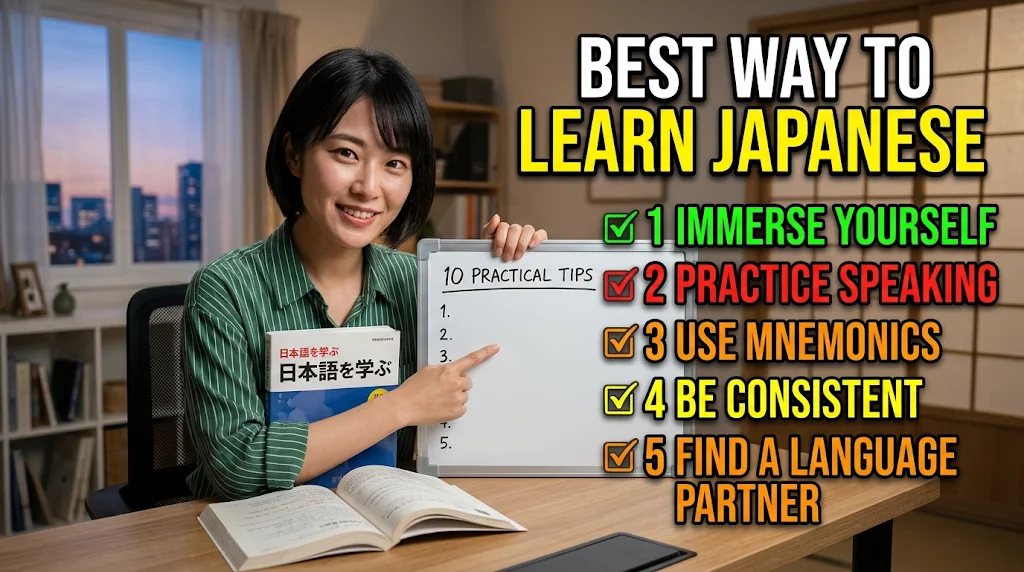
The best way to learn Japanese is to combine daily practice, hiragana and katakana study, basic grammar, vocabulary review, listening, and speaking. The five most effective methods are structured lessons, spaced repetition, immersion, conversation practice, and reading.
Learning Japanese can open doors to new cultures, career opportunities, travel experiences, and meaningful friendships. However, starting a completely different language can feel challenging without a clear learning strategy.
The best way to learn Japanese is to follow a structured routine that combines reading, writing, listening, speaking, and vocabulary practice. Instead of depending on one application, use several complementary learning methods.
Whether you’re a student, professional, traveler, or complete beginner, this guide will help you understand what to learn first, which resources to use, and how to build lasting language skills.
Quick Categories: Ways to Approach Japanese Learning
Different learning approaches suit different goals. Choose methods that support your current level and available study time.
Structured Learning Methods
- Beginner Japanese textbooks
- Online Japanese courses
- Guided grammar lessons
- Japanese language classes
Pro Tip: Follow one structured course instead of switching between several textbooks.
Technology-Based Learning
- Japanese learning applications
- Digital flashcards
- Online vocabulary quizzes
- Interactive grammar exercises
Pro Tip: Use applications for daily practice, not as your only learning resource.
Academic Learning Methods
- Japanese grammar textbooks
- University language courses
- JLPT preparation materials
- Guided reading exercises
Pro Tip: Learn grammar through complete sentences rather than memorizing isolated rules.
Immersive Learning Methods
- Japanese podcasts
- Japanese television programs
- YouTube videos
- Japanese news and articles
Pro Tip: Choose content you can understand partially. Completely unfamiliar material can become frustrating.
Conversational Learning Methods
- Online language exchanges
- Japanese speaking tutors
- Conversation clubs
- Daily speaking exercises
Pro Tip: Start speaking before you feel completely confident.
Casual Learning Methods
- Japanese songs
- Anime and dramas
- Japanese games
- Everyday vocabulary challenges
Pro Tip: Enjoyable activities help maintain motivation, but combine entertainment with active learning.
What Does Best Way to Learn Japanese Mean?
The phrase describes the most effective learning approach for developing Japanese language skills according to someone’s goals, experience, schedule, and resources.
It does not mean finding one perfect application or memorizing thousands of Japanese words.
Japanese uses three writing systems:
- Hiragana: A phonetic script commonly used for native Japanese words, grammatical endings, and particles.
- Katakana: A phonetic script frequently used for foreign loanwords, names, and emphasis.
- Kanji: Characters used to represent meaning and words, often alongside hiragana.
Japanese grammar also differs from English sentence structure. For example:
English: I drink water.
Japanese: 私は水を飲みます。
Romaji: Watashi wa mizu o nomimasu.
Meaning: I drink water.
A successful learning strategy gradually develops the ability to understand and produce sentences like this.
Best Way to Learn Japanese: When Should You Use Different Methods?
Your learning method should match your immediate goal.
| Learning situation | Recommended approach |
|---|---|
| Complete beginner | Hiragana and katakana |
| School student | Textbooks and grammar |
| Working professional | Business Japanese and speaking |
| Traveler | Everyday expressions and listening |
| JLPT candidate | Structured exam preparation |
| Anime enthusiast | Listening and reading practice |
| Independent learner | Self-study and language exchanges |
Learning Japanese for Different Goals
Daily conversations: Practice greetings, introductions, common questions, and everyday expressions.
Academic learning: Study grammar, vocabulary, reading comprehension, and writing.
Professional communication: Learn polite Japanese, workplace vocabulary, and appropriate communication styles.
Travel: Prioritize directions, transportation, shopping, restaurants, and polite requests.
Examinations: Follow the official JLPT levels, from N5 through N1, and use suitable practice materials.
Professional vs. Polite vs. Formal Japanese
Japanese communication requires attention to social context. Choosing the right expression matters as much as understanding its literal meaning.
| Communication style | Japanese expression | Meaning |
|---|---|---|
| Casual | ありがとう | Thank you |
| Polite | ありがとうございます | Thank you very much |
| Formal | 誠にありがとうございます | Thank you sincerely |
| Business | お世話になっております | A conventional professional greeting |
Polite Japanese is useful in everyday interactions with unfamiliar people. Formal language is suitable for more respectful or ceremonial situations.
Professional Japanese also includes business conventions. For example, workplace greetings and email openings may differ from expressions used among friends.
Important: Do not assume that longer Japanese expressions are always more polite. Context, relationship, and situation determine the appropriate language.
Pros and Cons of Different Japanese Learning Methods
Pros
- Flexible learning: Online resources let students study around their schedules.
- Affordable options: Free lessons, dictionaries, and audio resources reduce learning costs.
- Better retention: Regular vocabulary review strengthens long-term memory.
- Real communication: Speaking practice develops confidence and conversational ability.
- Cultural understanding: Japanese media introduces natural expressions and cultural context.
Cons
- Information overload: Too many applications and textbooks can create confusion.
- Limited speaking practice: Self-study alone may not provide enough conversation.
- Inconsistent motivation: Independent learners sometimes struggle to maintain routines.
- Slow progress: Japanese requires sustained effort, particularly for reading and kanji.
- Incorrect habits: Practicing without feedback can reinforce pronunciation or grammar mistakes.
Other Ways to Learn Japanese: 10 Methods With Examples
Here are ten practical approaches, arranged from foundational learning to more independent and specialized techniques.
Learn Hiragana First
Meaning: Hiragana is the foundation of Japanese reading.
Explanation: Learn its basic characters, sounds, and combinations before depending on romanized Japanese. This makes beginner textbooks and authentic Japanese material easier to understand.
Learning Level: Beginner
Difficulty: Easy to moderate
Best Use: Starting Japanese
Avoid: Relying on romaji permanently
Example: あ (a), い (i), う (u), え (e), お (o).
Practice contexts:
- Reading: Recognizing simple hiragana words.
- Speaking: Pronouncing Japanese vowels.
- Writing: Practicing individual characters.
Common combinations: か, き, く, け, こ.
Study Katakana
Meaning: Katakana is another phonetic Japanese writing system.
Explanation: It is commonly used for foreign words, borrowed vocabulary, foreign names, and certain forms of emphasis.
Learning Level: Beginner
Difficulty: Easy to moderate
Best Use: Reading loanwords
Avoid: Confusing similar-looking characters
Example: コーヒー (kōhī) means coffee.
Practice contexts:
- Reading: Recognizing borrowed words.
- Speaking: Pronouncing familiar loanwords.
- Writing: Practicing foreign names.
Common combinations: カ, キ, ク, ケ, コ.
Build a Daily Japanese Vocabulary Habit
Meaning: Learn useful Japanese words consistently.
Explanation: Focus on everyday vocabulary before collecting complicated or uncommon words. Learn each word through example sentences and pronunciation.
Learning Level: Beginner to advanced
Difficulty: Moderate
Best Use: Everyday communication
Avoid: Memorizing isolated translations
Example: 水 (mizu) means water.
Practice contexts:
- Reading: Recognizing familiar words.
- Speaking: Naming everyday objects.
- Writing: Creating short sentences.
Common vocabulary groups: Food, family, numbers, transportation, and greetings.
Follow a Structured Japanese Textbook
Meaning: Use a carefully organized learning resource.
Explanation: A textbook provides lessons in a logical sequence, including grammar explanations, vocabulary, exercises, and reading activities.
Learning Level: Beginner to advanced
Difficulty: Moderate
Best Use: Grammar foundations
Avoid: Studying multiple textbooks simultaneously
Example: Genki is a popular beginner textbook series.
Practice contexts:
- Reading: Understanding example passages.
- Speaking: Repeating lesson dialogues.
- Writing: Completing grammar exercises.
Useful study areas: Particles, verb forms, adjectives, sentence patterns, and questions.
Use Spaced Repetition for Vocabulary and Kanji
Meaning: Review information at gradually increasing intervals.
Explanation: Spaced repetition helps you revisit words and characters before you forget them. Digital flashcard tools such as Anki can organize these reviews.
Learning Level: Beginner to advanced
Difficulty: Moderate
Best Use: Long-term memory
Avoid: Adding more cards than you can review
Example: Review a newly learned Japanese word today, tomorrow, and again after a longer interval.
Practice contexts:
- Reading: Recognizing reviewed words.
- Speaking: Recalling vocabulary without prompts.
- Writing: Remembering kanji readings and meanings.
Useful review groups: Nouns, verbs, adjectives, kanji, and common expressions.
Native Speaker Tip: Methods 1–5
The strongest foundation comes from combining kana, vocabulary, grammar, and regular review. Japanese speakers do not learn through endless translation alone; they recognize familiar expressions in context.
For beginners, hiragana and katakana deserve early attention. Vocabulary becomes more useful when learned through natural sentences rather than isolated English equivalents.
Listen to Japanese Every Day
Meaning: Develop your ability to recognize spoken Japanese.
Explanation: Listening introduces natural pronunciation, sentence rhythm, vocabulary, and conversational expressions. Start with beginner audio before moving toward faster native material.
Learning Level: Beginner to advanced
Difficulty: Moderate
Best Use: Listening comprehension
Avoid: Listening without checking understanding
Example: Listen to a short Japanese dialogue and identify familiar greetings.
Practice contexts:
- Reading: Following a transcript.
- Speaking: Repeating recorded sentences.
- Conversation: Recognizing common questions.
Useful resources: NHK WORLD-JAPAN lessons, beginner podcasts, and graded audio.
Practice Speaking With a Tutor
Meaning: Develop communication skills through guided conversation.
Explanation: A tutor can correct pronunciation, explain unfamiliar expressions, and help you produce sentences naturally.
Learning Level: Beginner to advanced
Difficulty: Moderate to challenging
Best Use: Conversation development
Avoid: Waiting until you feel fluent
Example: Introduce yourself in Japanese and answer basic questions about your interests.
Practice contexts:
- Reading: Preparing conversation prompts.
- Speaking: Answering questions aloud.
- Professional communication: Practicing polite introductions.
Useful topics: Introductions, hobbies, family, work, and daily routines.
Use Japanese Immersion
Meaning: Surround yourself with Japanese-language content.
Explanation: Watch videos, read simple stories, listen to podcasts, and explore Japanese websites. Select material that matches your current understanding.
Learning Level: Beginner to advanced
Difficulty: Moderate to challenging
Best Use: Natural language exposure
Avoid: Depending entirely on English subtitles
Example: Watch a short Japanese video with Japanese subtitles and note three useful expressions.
Practice contexts:
- Reading: Following Japanese captions.
- Speaking: Repeating natural expressions.
- Listening: Identifying familiar vocabulary.
Useful content: Japanese dramas, YouTube channels, podcasts, and graded readers.
Join a Japanese Language Exchange
Meaning: Practice Japanese with another language learner or speaker.
Explanation: Language exchanges provide opportunities to ask questions, practice conversations, and receive feedback. Participants can take turns using each other’s languages.
Learning Level: Beginner to advanced
Difficulty: Moderate
Best Use: Real conversations
Avoid: Speaking without listening to your partner
Example: Spend 20 minutes practicing Japanese introductions and 20 minutes helping your partner with English.
Practice contexts:
- Reading: Exchanging written messages.
- Speaking: Discussing everyday topics.
- Casual conversation: Sharing hobbies and experiences.
Useful platforms: HelloTalk and Tandem.
Set Japanese Learning Goals and Take Practice Tests
Meaning: Measure progress through clear learning milestones.
Explanation: Goals make independent study easier to manage. The Japanese-Language Proficiency Test (JLPT) provides five levels, from N5 to N1.
Learning Level: Beginner to advanced
Difficulty: Moderate to challenging
Best Use: Progress tracking
Avoid: Treating test scores as your only measure of ability
Example: Prepare for beginner-level N5 practice questions after studying basic vocabulary and grammar.
Practice contexts:
- Reading: Answering comprehension questions.
- Speaking: Explaining familiar topics.
- Writing: Reviewing grammar and sentence construction.
Useful resources: JLPT practice questions, vocabulary lists, and mock examinations.
Native Speaker Tip: Methods 6–10
Listening and conversation are essential for understanding how Japanese is actually used. Textbooks teach useful structures, but real speakers also use shortened expressions, natural pauses, and context-dependent language.
The most balanced approach combines regular listening, guided speaking, and reading material that matches your level. Language exchanges are useful, but a qualified teacher can provide more systematic correction.
Expert Insight: Build a Balanced Japanese Study System
Learning Japanese effectively requires more than completing daily application exercises.
For workplace communication: Learn polite greetings, introductions, requests, and common business expressions. Practice speaking in realistic professional situations.
For email writing: Study conventional openings, polite requests, appropriate sentence endings, and respectful closings. Do not translate English business emails word for word.
For academic learning: Use structured textbooks, grammar exercises, graded reading, and vocabulary review. Build understanding before attempting advanced texts.
For natural conversation: Listen to Japanese speakers and practice responding without translating every sentence into English.
The most useful learning system gives every skill regular attention instead of allowing one skill to dominate.
Quick Recap: The Best Japanese Learning Methods
| Learning goal | Best choice |
|---|---|
| Best foundation | Hiragana and katakana |
| Best vocabulary method | Spaced repetition |
| Best grammar method | Structured textbooks |
| Best listening method | Daily Japanese audio |
| Best speaking method | Tutor conversations |
| Best immersion method | Japanese media |
| Best social practice | Language exchanges |
| Best progress measurement | JLPT practice |
Comparison Table: All 10 Learning Methods
| Method | Difficulty | Best Use | Learning Frequency |
|---|---|---|---|
| Hiragana | Easy–Moderate | Reading foundation | Daily |
| Katakana | Easy–Moderate | Reading loanwords | Daily |
| Vocabulary | Moderate | Word retention | Daily |
| Textbooks | Moderate | Grammar | 4–5 days weekly |
| Spaced repetition | Moderate | Memory | Daily |
| Listening | Moderate | Comprehension | Daily |
| Tutor lessons | Moderate–High | Speaking | Weekly |
| Immersion | Moderate–High | Natural exposure | Daily |
| Language exchange | Moderate | Conversation | Weekly |
| JLPT practice | Moderate–High | Assessment | Weekly |
Best Choice: Which Japanese Learning Method Should You Choose?
Best Overall: Combine structured lessons, vocabulary review, listening, and speaking. No single resource covers every skill equally well.
Beginners: Start with hiragana and katakana, then learn basic grammar and everyday vocabulary.
Academic Learning: Follow a structured textbook and practice reading, grammar, and writing regularly.
Business Japanese: Work with a teacher who can explain polite language, workplace expressions, and professional communication.
Everyday Conversation: Practice with tutors or language exchange partners while listening to beginner-friendly Japanese.
Most Flexible: Self-study with textbooks, flashcards, and free online lessons.
Best for Long-Term Progress: Combine consistent practice with regular feedback and realistic goals.
Commonly Confused Japanese Learning Approaches
Memorization vs. Understanding
Memorization helps you remember vocabulary, but understanding helps you use words correctly.
For example, knowing that 食べる means “to eat” is useful. Understanding how to use it in different sentence patterns is more valuable.
Listening vs. Passive Watching
Listening requires attention to sounds, expressions, and meaning. Watching videos without following the language may provide entertainment but limited learning value.
Grammar Study vs. Conversation Practice
Grammar teaches sentence structure. Conversation develops the ability to use that structure naturally.
Both are necessary for balanced communication.
Self-Study vs. Guided Learning
Self-study provides flexibility and independence. Guided learning provides feedback and a clearer learning sequence.
Combining both can help learners avoid common mistakes.
A Practical 30-Day Japanese Learning Plan
You do not need to master Japanese in one month. Your first goal should be building a routine and understanding the foundations.
| Period | Learning focus | Target |
|---|---|---|
| Days 1–7 | Hiragana and pronunciation | Recognize basic characters |
| Days 8–12 | Katakana | Read common loanwords |
| Days 13–17 | Basic vocabulary | Learn everyday words |
| Days 18–22 | Grammar | Build simple sentences |
| Days 23–26 | Listening and speaking | Practice short dialogues |
| Days 27–30 | Reading and revision | Review everything learned |
Suggested Daily Routine
- 10 minutes: Vocabulary review.
- 10 minutes: Grammar practice.
- 10 minutes: Japanese listening.
- 10 minutes: Reading or speaking.
Total: 40 minutes daily.
Adjust the schedule according to your availability. Consistent practice matters more than following an exact timetable.
Common Mistakes Japanese Learners Should Avoid
Depending on Romaji Too Long
Wrong approach: Reading every Japanese word through English letters.
Why incorrect: It delays familiarity with Japanese writing systems.
Better approach: Learn hiragana and katakana early.
Example: Read ありがとう as arigatō rather than depending permanently on romaji.
Learning Kanji Without Vocabulary
Wrong approach: Memorizing isolated characters without learning their words.
Why incorrect: Kanji readings and meanings often change according to context.
Better approach: Learn kanji through useful vocabulary and sentences.
Studying Too Many Resources
Wrong approach: Switching between several applications every day.
Why incorrect: Constantly changing resources makes progress difficult to measure.
Better approach: Choose one primary course and a few supporting tools.
Ignoring Listening Practice
Wrong approach: Studying only written grammar and vocabulary.
Why incorrect: Reading ability does not automatically develop listening comprehension.
Better approach: Listen to Japanese audio every day.
Avoiding Speaking Practice
Wrong approach: Waiting until you know enough Japanese to speak perfectly.
Why incorrect: Speaking requires active practice and feedback.
Better approach: Start with short introductions and simple questions.
Scenario Practice: Choose the Right Learning Method
Test your understanding with five everyday situations.
Situation : Business Meeting
You need to introduce yourself politely to Japanese colleagues. Which method should you prioritize?
Answer: Tutor-led conversation practice.
Why: A tutor can help you practice introductions, appropriate greetings, and polite expressions.
Situation : Job Interview
You want to understand common Japanese interview questions.
Answer: Listening practice and guided speaking.
Why: These methods prepare you to recognize questions and respond confidently.
Situation : Presentation
You need to explain a topic using clear Japanese sentences.
Answer: Structured grammar lessons and speaking practice.
Why: You need accurate sentence construction and the ability to communicate ideas aloud.
Situation : Classroom Discussion
You want to understand Japanese reading material.
Answer: Vocabulary review and graded reading.
Why: Familiar words and suitable reading exercises improve comprehension.
Situation : Email Reply
You need to write a polite response in Japanese.
Answer: Structured textbook learning and business Japanese instruction.
Why: You need to understand polite expressions, sentence endings, and professional conventions.
Mini Quiz: Test Your Japanese Learning Knowledge
Which writing system should most beginners prioritize first?
A. Kanji
B. Hiragana
C. Romaji
D. English
Which technique helps you review vocabulary at increasing intervals?
A. Passive watching
B. Random guessing
C. Spaced repetition
D. Translation only
What is a useful way to improve spoken Japanese?
A. Avoid conversations
B. Memorize kanji only
C. Practice with a tutor
D. Study without audio
Which Japanese writing system commonly represents foreign loanwords?
A. Hiragana
B. Katakana
C. Kanji
D. Romaji
What is the main purpose of taking JLPT practice tests?
A. Measuring Japanese proficiency
B. Learning English grammar
C. Avoiding vocabulary practice
D. Replacing conversation
Answer Key
- B: Hiragana.
- C: Spaced repetition.
- C: Practice with a tutor.
- B: Katakana.
- A: Measuring Japanese proficiency.
Frequently Asked Questions
What is the best way to learn Japanese for beginners?
Start with hiragana, katakana, basic pronunciation, and everyday vocabulary. Follow one structured beginner course, practice grammar through sentences, and include listening and speaking from your first weeks of study.
Can I learn Japanese by myself?
Yes. Self-study can build strong reading, vocabulary, and grammar skills. Use structured lessons, flashcards, audio resources, and graded readers. However, conversation partners or tutors provide valuable speaking practice and personalized corrections.
How many hours should I study Japanese daily?
A practical starting point is 30–60 minutes daily, divided between vocabulary, grammar, listening, and speaking. Your ideal schedule depends on your goals, available time, learning speed, and consistency.
Should I learn hiragana or kanji first?
Learn hiragana first, followed by katakana. Once you understand both phonetic scripts and basic sentence structures, introduce kanji gradually through useful vocabulary. This makes reading and remembering characters easier.
What is the fastest way to improve Japanese speaking?
Practice speaking regularly with a qualified tutor or language partner. Repeat short dialogues, answer everyday questions, and record yourself. Listening to native speakers also helps develop natural pronunciation and conversational understanding.
Conclusion
The best way to learn Japanese is to combine structured lessons, vocabulary practice, listening, reading, and regular speaking. Every method contributes something different, and no single application can replace a balanced learning routine. Start with hiragana and katakana, build your grammar foundation, and gradually introduce kanji and authentic Japanese content.
Remember that language learning is a process, not a competition. Practice consistently, celebrate small improvements, and use Japanese whenever possible. With patience and the right resources, you can gradually develop the confidence to understand and communicate in Japanese.

Ryan Foster is a creative writer at RepliesNext.com sharing witty replies pickup lines funny comebacks and conversation ideas to help readers always find the perfect words.