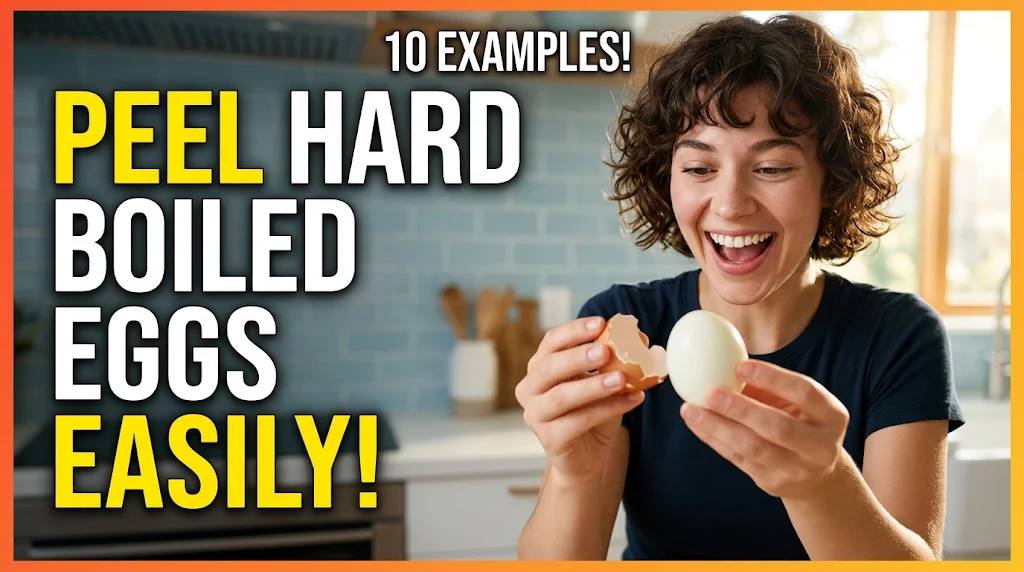
The best way to peel hard boiled eggs is to chill them in ice water, crack the wide end, and peel under running water. Alternatives include shell hard-cooked eggs, unshell boiled eggs, remove eggshells, de-shell eggs, and peel eggs cleanly.
The phrase best way to peel hard boiled eggs looks like a simple cooking question. It is also a useful language pattern. It combines a superlative, a purpose infinitive, and a compound adjective.
English offers many ways to express the same action. The right choice depends on your audience, your tone, and your purpose. A recipe blog needs warmth. A food-safety manual needs precision.
These alternatives help ESL students, food writers, culinary professionals, and teachers communicate with confidence. You will find them useful in recipes, emails, classroom instructions, and professional kitchens.
Quick Category Section: Alternative Phrases by Register
Formal Alternatives
- The optimal procedure for removing shells from hard-cooked eggs
- The most effective method of eggshell removal
- The recommended technique for shelling boiled eggs
Pro Tip: Formal phrases work best in written reports, food-science papers, and official guidance.
Professional Alternatives
- The standard method for peeling hard-boiled eggs
- The efficient approach to eggshell removal
- The production-ready technique for shelling eggs
Pro Tip: Professional language should be clear, not decorative. Choose one precise phrase and stay consistent.
Business Email Alternatives
- The approved method for peeling hard-boiled eggs
- The recommended shell-removal procedure
- The standard egg-peeling protocol
Pro Tip: In email, put the method in the subject line or the first sentence. Do not bury it.
Academic Alternatives
- The empirically supported method for eggshell removal
- The optimal technique for shelling hard-cooked eggs
- The documented procedure for peeling boiled eggs
Pro Tip: Academic writing values accuracy. Define your terms the first time you use them.
Casual Alternatives
- The easiest way to peel hard-boiled eggs
- The trick for getting shells off boiled eggs
- The no-fuss way to peel eggs
Pro Tip: Casual phrases are friendly, but they still need a clear verb. Avoid vague wording like do the egg thing.
Informal Expressions
- The hack for peeling boiled eggs
- The secret to shelling eggs
- The go-to trick for egg peeling
Pro Tip: Informal phrases suit blogs, videos, and conversation. Do not use them in formal safety documents.
Common Mistakes
Peel off the shell vs. peel the shell
- Wrong: Peel off the shell from the egg.
- Why: Off is redundant with from in this structure.
- Correct: Peel the shell from the egg. / Peel off the shell.
- Example: Peel the shell from the wide end first.
Peel the egg vs. peel the shell off the egg
- Wrong: Peel the egg carefully. (Ambiguous: the egg or the shell?)
- Why: Peel the egg can sound like you are peeling the egg itself.
- Correct: Peel the shell off the egg.
- Example: Peel the shell off the egg under running water.
Boiled egg vs. hard-boiled egg in formal writing
- Wrong: The boiled egg method was tested.
- Why: Boiled egg is vague; soft-boiled and hard-boiled are different.
- Correct: The hard-boiled egg method was tested.
- Example: The hard-boiled egg method reduced shell damage.
De-shell vs. remove the shell in formal writing
- Wrong: De-shell the eggs before service.
- Why: De-shell is informal and less transparent for global readers.
- Correct: Remove the shells from the eggs before service.
- Example: Remove the shells from the eggs before service.
Hard boiled vs. hard-boiled before a noun
- Wrong: hard boiled egg technique
- Why: Compound adjectives before nouns need a hyphen.
- Correct: hard-boiled egg technique
- Example: This hard-boiled egg technique is reliable.
What Does Best Way to Peel Hard Boiled Eggs Mean?
Definition: The phrase refers to the most effective method for removing the shell from a hard-cooked egg without damaging the egg white.
Grammar: Hard-boiled is a compound adjective. Hyphenate it before a noun. Peel is a transitive verb: you peel the egg, or you peel the shell from the egg.
Simple explanation: It means getting the shell off cleanly and quickly.
Example sentence: The best way to peel hard boiled eggs is to start at the wide end, where the air pocket sits.
The practical answer matters, too. Experts recommend an ice bath, a crack at the wide end, and peeling under running water. Slightly older eggs also peel more easily because their internal membrane loosens over time.
When to Use These Phrases
Business communication: Use professional alternatives in standard operating procedures, menu planning notes, and food-service training documents.
Emails: Use business email alternatives when you need to confirm a method with a team or a supplier.
Meetings: Use neutral or professional phrases when discussing recipe development or quality control.
Presentations: Use formal alternatives for demonstrations, and casual phrases for audience-friendly cooking shows.
Academic writing: Use academic alternatives in food-science papers, nutrition reports, and methodology sections.
Interviews: Use professional phrases in culinary job interviews to show technical vocabulary.
Daily conversations: Use casual and informal phrases with friends, family, and classmates.
Professional vs. Polite: What Is the Difference?
Polite language softens a request.
- Could you show me the best way to peel these eggs?
Professional language is clear and role-appropriate.
- The standard method for peeling hard-boiled eggs is an ice bath followed by peeling under running water.
Formal language is precise and often written.
- The optimal procedure for shell removal involves thermal shock and manual separation.
Natural language sounds like a fluent speaker.
- The easiest way to peel boiled eggs is to chill them first.
Politeness is about respect. Professionalism is about clarity. Formality is about distance. Naturalness is about fluency. Skilled communicators adjust all four.
Pros and Cons of Using Alternative Phrases
Pros
- Precision: You can match the phrase to the exact context.
- Audience awareness: You can sound formal in a report and friendly in a blog.
- Variety: You avoid repeating the same phrase in a long document.
- Language control: You show that you understand register and tone.
Cons
- Pretension risk: Overly formal phrases can sound stiff in casual settings.
- Complexity: A simple task can become wordy.
- Learner confusion: ESL students may struggle with low-frequency phrases.
- Warmth loss: Too much formality can make instructions feel cold.
Other Ways to Say Best Way to Peel Hard Boiled Eggs (With Examples)
The most effective method for shelling hard-cooked eggs
Meaning: The method that works best for removing shells from fully cooked eggs.
Explanation: Formal and precise. Shelling is a professional verb. Common in culinary and food-science writing.
Example Sentence: The most effective method for shelling hard-cooked eggs begins with an ice bath.
Best Use: Formal reports
Avoid Using In: Casual chat
Tone: Precise, formal
Formality Level: ⭐⭐⭐⭐⭐
Usage Frequency: Occasional
CEFR Level: C1
Common Collocations: shelling eggs, hard-cooked eggs, effective method, ice bath
Context Examples: Spoken English: rare; Professional English: common; Casual Conversation: rare
The optimal technique for removing eggshells
Meaning: The best technical approach to taking off eggshells.
Explanation: Formal and academic. Optimal signals evidence-based choice.
Example Sentence: The optimal technique for removing eggshells requires a thermal shock step.
Best Use: Academic writing
Avoid Using In: Informal videos
Tone: Analytical, formal
Formality Level: ⭐⭐⭐⭐⭐
Usage Frequency: Occasional
CEFR Level: C1
Common Collocations: optimal technique, remove eggshells, thermal shock, procedure
Context Examples: Spoken English: rare; Professional English: occasional; Casual Conversation: rare
The standard procedure for peeling hard-boiled eggs
Meaning: The accepted, routine way to peel hard-boiled eggs.
Explanation: Professional and neutral. Procedure suggests a repeatable process.
Example Sentence: The standard procedure for peeling hard-boiled eggs is posted in the kitchen.
Best Use: Workplace documents
Avoid Using In: Friendly conversation
Tone: Clear, professional
Formality Level: ⭐⭐⭐⭐
Usage Frequency: Common
CEFR Level: B2
Common Collocations: standard procedure, peeling eggs, kitchen protocol, follow steps
Context Examples: Spoken English: occasional; Professional English: common; Casual Conversation: rare
The foolproof way to unshell boiled eggs
Meaning: A method that always works for removing shells.
Explanation: Neutral and confident. Foolproof is reassuring but slightly informal.
Example Sentence: Chefs call this the foolproof way to unshell boiled eggs.
Best Use: Instructional blogs
Avoid Using In: Formal legal text
Tone: Confident, friendly
Formality Level: ⭐⭐⭐
Usage Frequency: Common
CEFR Level: B2
Common Collocations: foolproof way, unshell eggs, reliable method, easy peel
Context Examples: Spoken English: common; Professional English: occasional; Casual Conversation: common
The cleanest approach to de-shelling hard-cooked eggs
Meaning: The method that leaves the egg white smoothest.
Explanation: Professional and descriptive. De-shelling is jargon but widely understood in food service.
Example Sentence: The cleanest approach to de-shelling hard-cooked eggs uses running water.
Best Use: Culinary training
Avoid Using In: Academic papers
Tone: Technical, precise
Formality Level: ⭐⭐⭐⭐
Usage Frequency: Occasional
CEFR Level: C1
Common Collocations: de-shelling eggs, cleanest approach, smooth white, running water
Context Examples: Spoken English: occasional; Professional English: common; Casual Conversation: rare
The quickest method for eggshell removal
Meaning: The fastest way to remove eggshells.
Explanation: Neutral and practical. Focuses on speed, not necessarily quality.
Example Sentence: The quickest method for eggshell removal is the jar-shake technique.
Best Use: Time-saving tips
Avoid Using In: Fine-dining descriptions
Tone: Practical, neutral
Formality Level: ⭐⭐⭐
Usage Frequency: Common
CEFR Level: B2
Common Collocations: quickest method, eggshell removal, save time, batch peeling
Context Examples: Spoken English: common; Professional English: common; Casual Conversation: common
The go-to trick for peeling hard-boiled eggs
Meaning: The trusted trick that people rely on.
Explanation: Casual and conversational. Go-to signals personal recommendation.
Example Sentence: My go-to trick for peeling hard-boiled eggs is a five-minute ice bath.
Best Use: Casual conversation
Avoid Using In: Official manuals
Tone: Friendly, relaxed
Formality Level: ⭐⭐
Usage Frequency: Common
CEFR Level: B2
Common Collocations: go-to trick, peeling eggs, ice bath, kitchen tip
Context Examples: Spoken English: very common; Professional English: rare; Casual Conversation: very common
The no-fuss way to get shells off boiled eggs
Meaning: A simple method without complication.
Explanation: Casual and reassuring. No-fuss appeals to beginners.
Example Sentence: This is the no-fuss way to get shells off boiled eggs.
Best Use: Beginner guides
Avoid Using In: Technical reports
Tone: Warm, simple
Formality Level: ⭐⭐
Usage Frequency: Common
CEFR Level: B1
Common Collocations: no-fuss way, get shells off, boiled eggs, simple method
Context Examples: Spoken English: common; Professional English: rare; Casual Conversation: very common
The kitchen hack for peeling boiled eggs
Meaning: A clever shortcut for peeling boiled eggs.
Explanation: Informal and trendy. Hack is popular in online content.
Example Sentence: The kitchen hack for peeling boiled eggs involves a jar and ten seconds of shaking.
Best Use: Social media
Avoid Using In: Academic writing
Tone: Playful, informal
Formality Level: ⭐
Usage Frequency: Common
CEFR Level: B1
Common Collocations: kitchen hack, peeling eggs, quick tip, viral method
Context Examples: Spoken English: common; Professional English: rare; Casual Conversation: very common
The expert-recommended approach to peeling eggs
Meaning: The method that chefs and food experts recommend.
Explanation: Professional and trust-building. Appeals to authority without sounding academic.
Example Sentence: The expert-recommended approach to peeling eggs starts at the wide end.
Best Use: Brand content
Avoid Using In: Private notes
Tone: Authoritative, helpful
Formality Level: ⭐⭐⭐⭐
Usage Frequency: Occasional
CEFR Level: B2
Common Collocations: expert-recommended, peeling eggs, wide end, reliable results
Context Examples: Spoken English: occasional; Professional English: common; Casual Conversation: occasional
Native Speaker Tip (After Alternatives 1–5)
The most natural phrase in everyday speech is the easiest way to peel hard-boiled eggs. The most professional phrase is the standard procedure for peeling hard-boiled eggs. The less common phrase is the optimal technique for removing eggshells, which sounds academic. Native speakers usually prefer clear, short phrases unless they are writing for a technical audience.
Native Speaker Tip (After Alternatives 6–10)
The most natural casual phrase is the go-to trick for peeling eggs. The most professional phrase in this group is the expert-recommended approach to peeling eggs. The least common phrase is the kitchen hack for peeling boiled eggs in formal writing. Native speakers enjoy hack in videos, but they avoid it in workplace documents.
Expert Insight
Workplace communication: Use standard procedure and approved method in kitchens and food-service teams. These phrases reduce ambiguity.
Email writing: Put the method in the subject line. For example: Approved method for peeling hard-boiled eggs.
Academic English: Use optimal technique and procedure. Define hard-cooked the first time you use it.
Professional tone: Professional does not mean complicated. The standard method for peeling hard-boiled eggs is professional because it is clear.
Quick Recap Box
| Choice | Phrase |
| Best Professional Choice | The standard procedure for peeling hard-boiled eggs |
| Best Casual Choice | The go-to trick for peeling hard-boiled eggs |
| Best Formal Choice | The most effective method for shelling hard-cooked eggs |
| Most Natural Choice | The easiest way to peel hard-boiled eggs |
| Most Polite Choice | Could you show me the best way to peel these eggs? |
Comparison Table: Best Way to Peel Hard Boiled Eggs Alternatives
| Phrase | Tone | Formality | Best Use | Frequency |
| The most effective method for shelling hard-cooked eggs | Precise | ⭐⭐⭐⭐⭐ | Formal reports | Occasional |
| The optimal technique for removing eggshells | Analytical | ⭐⭐⭐⭐⭐ | Academic writing | Occasional |
| The standard procedure for peeling hard-boiled eggs | Clear | ⭐⭐⭐⭐ | Workplace documents | Common |
| The foolproof way to unshell boiled eggs | Confident | ⭐⭐⭐ | Instructional blogs | Common |
| The cleanest approach to de-shelling hard-cooked eggs | Technical | ⭐⭐⭐⭐ | Culinary training | Occasional |
| The quickest method for eggshell removal | Practical | ⭐⭐⭐ | Time-saving tips | Common |
| The go-to trick for peeling hard-boiled eggs | Friendly | ⭐⭐ | Casual conversation | Common |
| The no-fuss way to get shells off boiled eggs | Warm | ⭐⭐ | Beginner guides | Common |
| The kitchen hack for peeling boiled eggs | Playful | ⭐ | Social media | Common |
| The expert-recommended approach to peeling eggs | Authoritative | ⭐⭐⭐⭐ | Brand content | Occasional |
Best Choice Section
Best Overall: The easiest way to peel hard-boiled eggs. It is clear, natural, and widely understood.
Best Professional: The standard procedure for peeling hard-boiled eggs. It signals consistency and training.
Best Academic: The optimal technique for removing eggshells. It sounds evidence-based and precise.
Best Business Email: The approved method for peeling hard-boiled eggs. It is direct and actionable.
Best Everyday Conversation: The go-to trick for peeling hard-boiled eggs. It sounds like a real person talking.
Most Natural: The easiest way to peel boiled eggs. Native speakers use this pattern often.
Most Polite: Could you show me the best way to peel these eggs? It turns a statement into a respectful request.
Commonly Confused Phrases
Peel the egg vs. Peel the shell
Peel the egg is common in speech, but it can be ambiguous. Peel the shell is more precise in writing.
Hard-boiled vs. Hard-cooked
Hard-boiled is the everyday term. Hard-cooked is common in professional and academic food writing.
De-shell vs. Shell
De-shell means to remove the shell. Shell as a verb can mean the same thing, but it is less common and can confuse learners.
Unshell vs. Remove the shell
Unshell is compact and slightly technical. Remove the shell is clearer for a global audience.
Scenario Practice
Business meeting: You are presenting a new kitchen workflow. Which phrase do you choose?
Answer: The standard procedure for peeling hard-boiled eggs. It sounds professional and implies a repeatable process.
Interview: A chef asks how you handle egg preparation. Which phrase?
Answer: The most effective method for shelling hard-cooked eggs. It shows technical vocabulary.
Presentation: You are demonstrating a recipe to home cooks. Which phrase?
Answer: The easiest way to peel hard-boiled eggs. It is friendly and clear.
Classroom discussion: You are teaching ESL students a cooking lesson. Which phrase?
Answer: The no-fuss way to get shells off boiled eggs. It is simple and reassuring.
Email reply: A colleague asks for the method. Which phrase?
Answer: The approved method for peeling hard-boiled eggs is attached. It is direct and professional.
Mini Quiz
Which phrase is most formal?
A) The kitchen hack for peeling eggs
B) The optimal technique for removing eggshells
C) The easiest way to peel eggs
D) The go-to trick for peeling eggs
Which phrase is best for a business email?
A) The no-fuss way to get shells off
B) The approved method for peeling hard-boiled eggs
C) The secret to shelling eggs
D) The kitchen hack for peeling eggs
Which phrase is informal?
A) The standard procedure
B) The kitchen hack
C) The optimal technique
D) The expert-recommended approach
Which sentence is correct?
A) Peel off the shell from the egg.
B) Peel the shell from the egg.
C) Peel the egg from the shell.
D) Peel off the egg.
Which phrase is most natural in casual conversation?
A) The empirically supported method
B) The go-to trick for peeling hard-boiled eggs
C) The documented procedure
D) The optimal procedure
Answer Key: 1-B, 2-B, 3-B, 4-B, 5-B
FAQs
What is the best way to peel hard boiled eggs quickly?
Chill the eggs in ice water for a few minutes. Crack the wide end, then peel under running water. The cold water loosens the membrane and helps the shell slip off.
Are there formal alternatives to best way to peel hard boiled eggs?
Yes. Formal alternatives include the optimal procedure for shell removal and the most effective method for shelling hard-cooked eggs. These suit reports and academic writing.
Why do older eggs peel more easily?
As eggs age, they lose carbon dioxide and their pH rises. This weakens the bond between the egg white and the inner membrane, so the shell releases more easily.
Does adding baking soda or vinegar help with peeling?
Experts say these additives do not reliably help. Focus on egg age, a hot start, and a cold shock instead.
What is the most professional way to say peel hard boiled eggs?
The standard procedure for peeling hard-boiled eggs is clear, professional, and suitable for workplace documents and training materials.
Conclusion
The best way to peel hard boiled eggs is a practical skill, but the words you use to describe it matter too. Clear vocabulary helps you sound confident in kitchens, classrooms, and professional emails.
Practice one new phrase each day. Start with the easiest way in casual talk, then try the standard procedure in written work. With steady practice, you will communicate with precision and confidence.

Ryan Foster is a creative writer at RepliesNext.com sharing witty replies pickup lines funny comebacks and conversation ideas to help readers always find the perfect words.