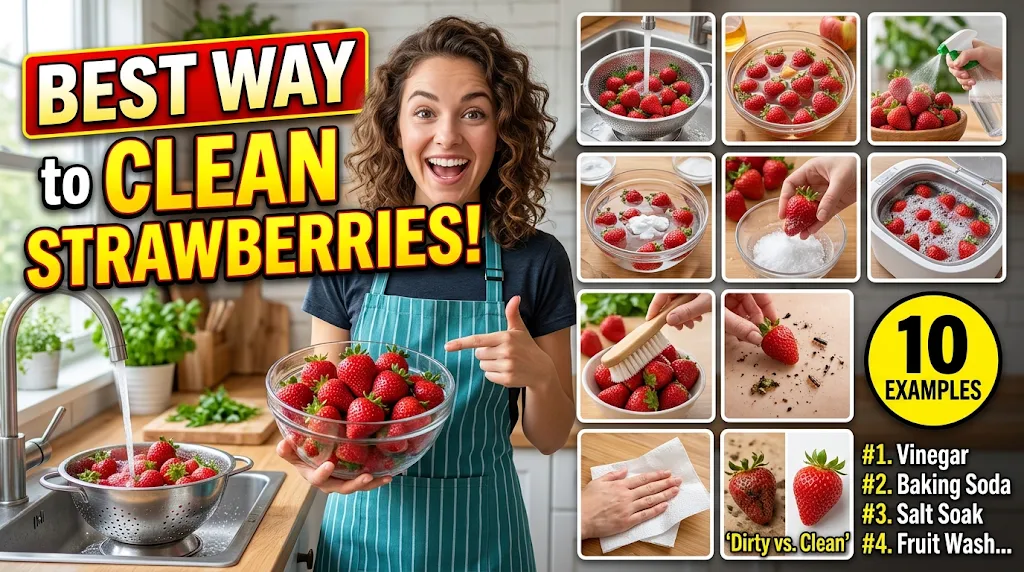
The best way to clean strawberries is a cool rinse a gentle rub a short baking soda dip and a final rinse. Also say: the most effective method the recommended approach the proper way the safest way the right way.
Cleaning strawberries looks simple but the details matter. A quick rinse can leave dirt and residue behind. A long soak can make the fruit soft and watery.
This guide explains the best way to clean strawberries using food-safety advice. It also teaches 10 natural English alternatives for the same idea. These phrases help ESL students teachers and writers sound clear and varied.
You will learn meaning tone common mistakes and real examples. Use the tables and quiz to check your understanding.
Quick Category Section
Formal Alternatives
- The recommended approach to cleaning strawberries
- The most effective method for washing strawberries
- The proper procedure for cleaning strawberries
Pro Tip: Use these in reports guidelines and academic writing.
Professional Alternatives
- The safest way to prepare strawberries for eating
- The standard method for washing strawberries
- The best practice for cleaning strawberries
Pro Tip: Best practice signals expert agreement.
Business Email Alternatives
- The recommended cleaning method for strawberries
- The proper washing steps for strawberries
- Our approved strawberry-cleaning process
Pro Tip: Keep email phrases direct and action-focused.
Academic Alternatives
- The most effective technique for removing surface residue from strawberries
- The validated method for washing strawberries
- The optimal cleaning protocol for strawberries
Pro Tip: Avoid best in academic writing; use effective or validated.
Casual Alternatives
- The right way to wash strawberries
- The easiest way to clean strawberries
- The quickest way to rinse strawberries
Pro Tip: Casual phrases work well in speech and blogs.
Informal Expressions
- The go-to way to clean strawberries
- The no-fuss strawberry rinse
- The trick for washing strawberries
Pro Tip: Avoid informal phrases in formal writing.
Common Mistakes
Soaking strawberries for 15–20 minutes
- Why incorrect: Thin skins absorb water so the fruit turns mushy and loses flavor.
- Correct phrase: Dip the berries for 30–60 seconds then rinse.
- Example: A short dip is enough; do not leave them in the bowl.
Washing berries before storage
- Why incorrect: Extra moisture speeds up mold growth.
- Correct phrase: Store them unwashed and wash just before eating.
- Example: I rinse only the portion I plan to eat.
Using soap or detergent
- Why incorrect: The FDA does not recommend soap on produce and porous fruit can absorb it.
- Correct phrase: Use cool water baking soda or white vinegar.
- Example: Skip the dish soap and use a baking soda dip instead.
Repeating best way in every sentence
- Why incorrect: It sounds repetitive and vague.
- Correct phrase: Try ‘recommended approach’ or ‘most effective method.’
- Example: The recommended approach is a cool rinse and a short dip.
Hulling before washing
- Why incorrect: Removing the cap opens the flesh and increases water absorption.
- Correct phrase: Wash first then hull.
- Example: Keep the green caps on until you are ready to eat.
What Does Best Way to Clean Strawberries Mean?
Definition: It means the most effective method for removing dirt surface residue and tiny insects from strawberries before eating.
Grammar: Best is a superlative adjective. To clean is an infinitive of purpose. The whole phrase works as a noun phrase.
Simple explanation: It is the method that gives the cleanest safest berry without damaging the fruit.
Example sentence: The best way to clean strawberries is a cool rinse a gentle rub and a short baking soda dip.
When to Use These Phrases
- Business communication: Use recommended approach in food-safety updates.
- Emails: Use proper washing steps in instructions to staff.
- Meetings: Use standard method when agreeing on kitchen rules.
- Presentations: Use most effective method when comparing options.
- Academic writing: Use validated method or optimal protocol.
- Interviews: Use best practice in food-service job answers.
- Daily conversations: Use the right way or my go-to method.
Professional vs Polite
- Polite: Would you mind rinsing the strawberries before serving? Soft and considerate.
- Professional: Please follow the recommended cleaning steps. Clear and neutral.
- Formal: The validated method involves a brief baking soda immersion. Structured and technical.
- Natural: Just give them a quick rinse and pat them dry. Conversational and direct.
Pros and Cons
Pros
- Removes more surface residue than a quick rinse alone.
- Takes only one to two minutes.
- Uses cheap pantry ingredients: baking soda or vinegar.
- Keeps berries firmer than a long soak.
Cons
- Adds an extra step before eating.
- Vinegar can slightly affect flavor if you use too much.
- Experts give different dip times which can confuse readers.
- No method removes 100% of pesticide residue.
Other Ways to Say Best Way to Clean Strawberries With Examples
The recommended approach to cleaning strawberries
Meaning: The method experts suggest.
Explanation: Formal and neutral; common in guides and food-safety writing.
Example: The recommended approach to cleaning strawberries is a cool rinse followed by a short baking soda dip.
Best Use: Reports and guides
Avoid Using In: Casual chat
Tone: Formal clear
Formality Level: ⭐⭐⭐⭐
Usage Frequency: Common
CEFR Level: B2
Common Collocations: recommended approach cleaning strawberries food-safety guidance
Context Examples: Spoken English: What’s the recommended approach? Professional English: We follow the recommended approach. Casual Conversation: less common.
The most effective method for washing strawberries
Meaning: The method that works best.
Explanation: Formal to neutral; emphasizes results.
Example: The most effective method for washing strawberries combines running water with a short baking soda dip.
Best Use: Comparison writing
Avoid Using In: Informal speech
Tone: Analytical
Formality Level: ⭐⭐⭐⭐
Usage Frequency: Common
CEFR Level: B2
Common Collocations: most effective method washing strawberries remove residue
Context Examples: Spoken English: Which is the most effective method? Professional English: Evidence supports the most effective method. Casual Conversation: rare.
The proper way to wash strawberries
Meaning: The correct or accepted way.
Explanation: Neutral; common in instructional writing.
Example: The proper way to wash strawberries is to rinse them under cool water and pat them dry.
Best Use: How-to content
Avoid Using In: Academic journals
Tone: Instructional
Formality Level: ⭐⭐⭐
Usage Frequency: Very Common
CEFR Level: B1
Common Collocations: proper way wash strawberries cool water pat dry
Context Examples: Spoken English: This is the proper way. Professional English: Staff should follow the proper way. Casual Conversation: I finally learned the proper way.
The right way to clean strawberries
Meaning: The correct method.
Explanation: Neutral to casual; friendly and direct.
Example: The right way to clean strawberries takes less than two minutes.
Best Use: Blogs and videos
Avoid Using In: Formal reports
Tone: Friendly
Formality Level: ⭐⭐
Usage Frequency: Very Common
CEFR Level: B1
Common Collocations: right way clean strawberries quick rinse easy steps
Context Examples: Spoken English: Do you know the right way? Professional English: less common. Casual Conversation: This is the right way to do it.
The safest way to prepare strawberries for eating
Meaning: The method that minimizes health risk.
Explanation: Professional; focuses on food safety.
Example: The safest way to prepare strawberries for eating is to wash them just before serving.
Best Use: Health communication
Avoid Using In: Recipe titles
Tone: Reassuring
Formality Level: ⭐⭐⭐⭐
Usage Frequency: Common
CEFR Level: B2
Common Collocations: safest way prepare strawberries food safety reduce risk
Context Examples: Spoken English: What’s the safest way? Professional English: We recommend the safest way for guests. Casual Conversation: I want the safest way for my kids.
Native Speaker Tip 1–5: Most natural: the right way to clean strawberries. Most professional: the recommended approach. Less common: the most effective method in everyday speech. Native speakers usually choose short direct phrases.
The best method for removing pesticides from strawberries
Meaning: The method that reduces pesticide residue most effectively.
Explanation: Academic and technical; common in food-science writing.
Example: The best method for removing pesticides from strawberries may be a brief baking soda soak.
Best Use: Research summaries
Avoid Using In: Casual conversation
Tone: Technical
Formality Level: ⭐⭐⭐⭐⭐
Usage Frequency: Occasional
CEFR Level: C1
Common Collocations: pesticide residue removal method baking soda solution
Context Examples: Spoken English: rare. Professional English: The study compares methods for removing pesticides. Casual Conversation: very rare.
The most thorough way to clean strawberries
Meaning: The most complete method.
Explanation: Professional; suggests extra care.
Example: The most thorough way to clean strawberries includes a vinegar dip and a final rinse.
Best Use: Premium food content
Avoid Using In: Quick tips
Tone: Confident
Formality Level: ⭐⭐⭐
Usage Frequency: Occasional
CEFR Level: B2
Common Collocations: thorough way clean strawberries vinegar dip final rinse
Context Examples: Spoken English: This is the most thorough way. Professional English: For events use the most thorough way. Casual Conversation: I don’t always do the most thorough way.
A reliable way to wash strawberries
Meaning: A method you can trust.
Explanation: Neutral; modest and practical.
Example: A reliable way to wash strawberries is to rinse them in a colander under cold running water.
Best Use: Everyday instruction
Avoid Using In: Marketing claims
Tone: Practical
Formality Level: ⭐⭐⭐
Usage Frequency: Common
CEFR Level: B1
Common Collocations: reliable way wash strawberries colander cold running water
Context Examples: Spoken English: That’s a reliable way. Professional English: Use a reliable way to protect guests. Casual Conversation: It’s a reliable way to get them clean.
The quickest way to clean strawberries
Meaning: The fastest method.
Explanation: Casual; focuses on speed.
Example: The quickest way to clean strawberries is a 30-second rinse under the tap.
Best Use: Busy-weeknight content
Avoid Using In: Food-safety guidance
Tone: Upbeat
Formality Level: ⭐⭐
Usage Frequency: Common
CEFR Level: B1
Common Collocations: quickest way clean strawberries under the tap busy morning
Context Examples: Spoken English: What’s the quickest way? Professional English: rare. Casual Conversation: I need the quickest way before breakfast.
The go-to method for cleaning strawberries
Meaning: The method people use by default.
Explanation: Informal; conversational and friendly.
Example: My go-to method for cleaning strawberries is a quick vinegar dip.
Best Use: Social media
Avoid Using In: Formal emails
Tone: Casual
Formality Level: ⭐
Usage Frequency: Occasional
CEFR Level: B2
Common Collocations: go-to method cleaning strawberries kitchen routine quick dip
Context Examples: Spoken English: That’s my go-to method. Professional English: rare. Casual Conversation: What’s your go-to method?
Native Speaker Tip 6–10: Most natural: the go-to method in casual talk. Most professional: the safest way to prepare strawberries. Less common: the quickest way in expert writing. Native speakers prefer rinse over wash for the quick step.
Expert Insight
In workplace communication choose phrases that signal safety and clarity. Recommended approach and best practice work well in emails and meetings. In academic English validated method or optimal protocol carries more authority than best way. In professional writing keep the phrase short and pair it with a clear action: The recommended approach is a cool rinse a short dip and a final rinse.
Quick Recap Box
- Best Professional Choice: The recommended approach to cleaning strawberries
- Best Casual Choice: The right way to clean strawberries
- Best Formal Choice: The validated method for washing strawberries
- Most Natural Choice: The proper way to wash strawberries
- Most Polite Choice: The safest way to prepare strawberries for eating
Comparison Table
| Phrase | Tone | Formality | Best Use | Frequency |
| The recommended approach to cleaning strawberries | Formal clear | ⭐⭐⭐⭐ | Reports and guides | Common |
| The most effective method for washing strawberries | Analytical | ⭐⭐⭐⭐ | Comparison writing | Common |
| The proper way to wash strawberries | Instructional | ⭐⭐⭐ | How-to content | Very Common |
| The right way to clean strawberries | Friendly | ⭐⭐ | Blogs and videos | Very Common |
| The safest way to prepare strawberries for eating | Reassuring | ⭐⭐⭐⭐ | Health communication | Common |
| The best method for removing pesticides from strawberries | Technical | ⭐⭐⭐⭐⭐ | Research summaries | Occasional |
| The most thorough way to clean strawberries | Confident | ⭐⭐⭐ | Premium food content | Occasional |
| A reliable way to wash strawberries | Practical | ⭐⭐⭐ | Everyday instruction | Common |
| The quickest way to clean strawberries | Upbeat | ⭐⭐ | Busy-weeknight content | Common |
| The go-to method for cleaning strawberries | Casual | ⭐ | Social media | Occasional |
Best Choice Section
- Best Overall: The recommended approach to cleaning strawberries. It is clear formal enough for most contexts and easy to understand.
- Best Professional: The safest way to prepare strawberries for eating. It puts health first.
- Best Academic: The validated method for washing strawberries. It sounds evidence-based.
- Best Business Email: The recommended cleaning method for strawberries. It is direct and action-focused.
- Best Everyday Conversation: The right way to clean strawberries. It sounds natural and friendly.
- Most Natural: The proper way to wash strawberries. It is common in instructional speech.
- Most Polite: The safest way to prepare strawberries for eating. It shows care for others.
Commonly Confused Phrases
- Wash vs. rinse: Wash suggests a fuller clean with rubbing or a dip. Rinse means running water only. Use rinse for the quick step.
- Clean vs. sanitize: Clean removes visible dirt. Sanitize kills germs. Strawberries are not usually sanitized at home.
- Best vs. easiest: Best focuses on effectiveness. Easiest focuses on convenience. They are not always the same.
- Pesticides vs. bacteria: Pesticides are chemical residues. Bacteria are germs. A rinse helps with both but the language should match the risk.
Scenario Practice
Business meeting: You are updating a café team on fruit safety. Which phrase would you choose?
Answer: The recommended approach to cleaning strawberries. It sounds professional and authoritative.
Interview: You are applying for a food-service job. Which phrase would you choose?
Answer: The safest way to prepare strawberries for eating. It shows you understand food safety.
Presentation: You are comparing cleaning methods. Which phrase would you choose?
Answer: The most effective method for washing strawberries. It signals analysis.
Classroom discussion: You are explaining the topic to ESL students. Which phrase would you choose?
Answer: The right way to clean strawberries. It is simple and clear.
Email reply: A colleague asks how to prepare berries for an event. Which phrase would you choose?
Answer: The proper washing steps for strawberries. It is direct and action-focused.
Mini Quiz
1. Which phrase is the most formal?
A The go-to method
B The right way
C The validated method
D The quickest way
Answer: C
2. Which phrase is best for a casual blog post?
A The optimal cleaning protocol
B The right way to clean strawberries
C The validated method
D The recommended approach
Answer: B
3. Which sentence is correct?
A The best way to cleaning strawberries is a rinse.
B The best way to clean strawberries is a rinse.
C The best way clean strawberries is a rinse.
D The best way for clean strawberries is a rinse.
Answer: B
4. Which phrase sounds most polite?
A The quickest way
B The safest way to prepare strawberries for eating
C The go-to method
D The proper way
Answer: B
5. Which phrase is most suitable for academic writing?
A The best method for removing pesticides from strawberries
B The trick for washing strawberries
C The no-fuss strawberry rinse
D The right way
Answer: A
FAQs
Should I wash strawberries with vinegar or baking soda?
Both work for a deeper clean. A short baking soda dip is gentle while a one-part vinegar to three-parts water dip can reduce surface mold spores. Rinse well afterward.
Can I wash strawberries before storing them?
No. Washing adds moisture and speeds up spoilage. Store strawberries unwashed and rinse them just before eating or preparing them.
How long should I soak strawberries?
Keep the dip short. Harvard recommends a 30- to 60-second baking soda dip for strawberries because their thin skins absorb liquid quickly.
Do I need to hull strawberries before washing?
No. Leave the green caps on during washing. Hulling opens the flesh and lets water in so remove the caps after washing or just before eating.
Is tap water enough to clean strawberries?
For many home cooks a cool running-water rinse with a gentle rub is enough. A short baking soda or vinegar dip adds extra cleaning power for conventionally grown berries.
Conclusion
The best way to clean strawberries is simple: rinse rub gently dip briefly and rinse again. The language you use to describe this process matters too. Clear phrases build trust in kitchens classrooms and workplaces.
Practice one new phrase each day. Try recommended approach in a report and the right way in a conversation. With small steady practice you will sound more confident and more precise.

Ryan Foster is a creative writer at RepliesNext.com sharing witty replies pickup lines funny comebacks and conversation ideas to help readers always find the perfect words.